
Two-dimensional density estimation
Source:vignettes/two-dimensional-density.Rmd
two-dimensional-density.RmdThis vignette illustrates two-dimensional density estimation and visualization. It complements the estimator-choice vignette by focusing on the 2D workflow.
Simulated example
The example uses a small reproducible mixture so the vignette remains quick to build.
Grid estimation
grid_fit <- glbfp_estimate(x, b = b, m = c(1, 1), grid_size = 20)
summary(grid_fit)
#> Method: GLBFP
#> Dimension: 2
#> Grid points: 400
#> Grid type: rectangular
#> Grid dimensions: 20 x 20
#> Bandwidths (b): 0.321036127107069, 0.315953610723842
#> Shifts (m): 1, 1
#> Density range: 0 to 0.210331281836707
#> Density quartiles: 0, 0.00348642703612875, 0.0356905349965338
#> Density median: 0.003486427
#> Density mean: 0.02480127
#> Zero densities: 188
#> Standard error median: 0.007210991
#> Median visited cells: 1
#> Median prefix nodes: 6
head(as.data.frame(grid_fit))
#>          x1        x2 density sd IC_lower IC_upper visited prefix_nodes
#> 1 -2.974658 -2.888704       0  0        0        0       0            6
#> 2 -2.657723 -2.888704       0  0        0        0       0            6
#> 3 -2.340789 -2.888704       0  0        0        0       0            6
#> 4 -2.023855 -2.888704       0  0        0        0       0            6
#> 5 -1.706920 -2.888704       0  0        0        0       0            6
#> 6 -1.389986 -2.888704       0  0        0        0       0            6
Visualization
For two-dimensional regular grids, contour = TRUE
returns a static ggplot2 contour plot.
plot(grid_fit, contour = TRUE)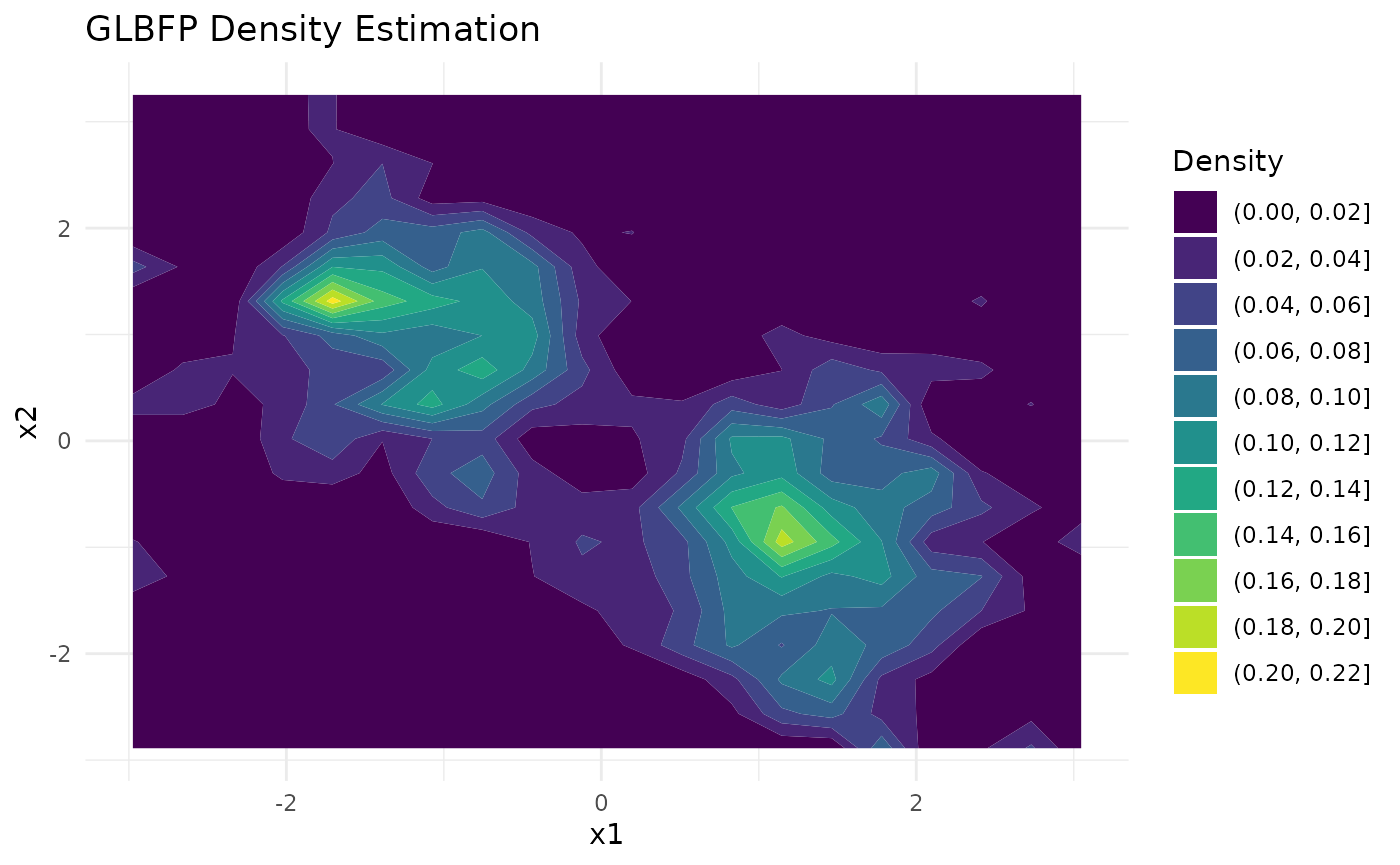
With contour = FALSE, the plot method returns an
interactive plotly surface. This is useful for exploration.
Static contours are usually easier to reproduce in manuscripts.
surface <- plot(grid_fit, contour = FALSE)
surface